

Tuesday, 23 February 2010
Swansea seminar on migration
Speaking at a seminar on migration, hosted by Heaven Crawley, professor of Migration at the University. I met Heaven six years ago in St James's Church, Piccadilly, when she spoke at a debate we held during Refugee Week around Pero Mandic's paintings, Crimson Harvest.


Monday, 22 February 2010
Installing the exhibition and long drive to Swansea
An early start at Penair School, Truro, where we install the exhibition. A new arrival is a very powerful Relic Box by Patrick Coleman. It's a 3D scrapbook in his late father's toolbox, a scrapbook of mementos and ephemera from his life. It is very powerful and at the same time very delicate - protected here by a perspex box created by Alex White, University College Falmouth.


 Tanya Davies and Carmel Henry - the Citizenship team at Penair who have really thrown themselves behind the project.


 Tanya Davies and Carmel Henry - the Citizenship team at Penair who have really thrown themselves behind the project.
And finally, a long drive north and west - to Swansea, where am speaking at a seminar on migration tomorrow.

Thursday, 18 February 2010
The pickers arrive - a new pastoral

Driving home on the Helston road, pass the same field, where the daffodils don't seem to have come along much. But a bus has arrived, bringing workers. The pickers are at work nearby. A 21st century pastoral landscape.
Tuesday, 16 February 2010
Creating new map boxes at Truro Library
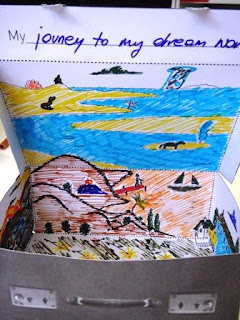
A very gentle day after the meetings and discussions of last week... the opening of the newly refurbished Truro Library, Truro, Cornwall, and Ewa and I run a drop-in workshop in the Children's Library: I Packed This Myself: What's In A Suitcase? The space is large and airy: the children love making map boxes. And Ewa has made several plates of Polish cheesecake, which she hands around.

 The map boxes, designed by the tireless David Cross. They are inspired by four suitcases, with maps of different stages of a journey, which have been created by illustrator Glyn Goodwin. People can drawn their own maps, reflecting metaphorical journeys they have made, and then cut them up and make them into suitcases. They can take them home and keep things in them. On the base of each box/suitcase is a key fact about migrant workers and migration. Abbie, aged five, is in the library with her mother and three-year-old brother, Jack, who eats a lot of cheesecake. Abbie draws things that remind her of home in her suitcase.


 Visitors are very interested in the cheesecake and ask Ewa for the recipe. However she is busy with her own case
She does promise the recipe to one keen visitor, Mrs Vee Stott, who comes back several times for more (we will put the recipe in the post). It is interesting to find that the vocabulary for cooking is quite difficult. It's easy enough to come up with a list of ingredients - but expressions involving actions like 'separating the eggs', 'folding in', 'beating' ... are trickier.
Mrs Stott talks about English cake traditions, some of which are new to me. She tells Ewa about 'cut and come again cakes' - these are fruit cakes, intended to last for some time.
And the expression 'I'm going to straighten that up', which she thinks comes from Yorkshire. Her late husband used to say .e.g 'I'm going to straighten up that bread and butter pudding'. i.e. finish it off.
Later, Ewa and I go to the Cathedral next door for a cup of tea and our usual review meeting. Ewa sees a woman priest for the first time.


She does promise the recipe to one keen visitor, Mrs Vee Stott, who comes back several times for more (we will put the recipe in the post). It is interesting to find that the vocabulary for cooking is quite difficult. It's easy enough to come up with a list of ingredients - but expressions involving actions like 'separating the eggs', 'folding in', 'beating' ... are trickier.
Mrs Stott talks about English cake traditions, some of which are new to me. She tells Ewa about 'cut and come again cakes' - these are fruit cakes, intended to last for some time.
And the expression 'I'm going to straighten that up', which she thinks comes from Yorkshire. Her late husband used to say .e.g 'I'm going to straighten up that bread and butter pudding'. i.e. finish it off.
Later, Ewa and I go to the Cathedral next door for a cup of tea and our usual review meeting. Ewa sees a woman priest for the first time.
Monday, 15 February 2010
A Relic Box and a swift meeting with Patrick Coleman in Haringay

A very swift meeting with artist Patrick Coleman in Haringay, as he hands over A Relic Box, a 3D scrapbook he has created in a toolbox, which belonged to his father who arrived in this country from Ireland in the early 1950s. It is going to join the exhibition, to be installed at Penair School, Truro, next week. Am so pleased that it will be part of the show - it is an incredibly powerful piece.

A swift handover because parking on his street in Haringay is impossible. So much traffic and to-ing and fro-ing.
Sunday, 14 February 2010
A review of the week....
A busy week but time this morning to reflect and sharpen the real focus of the project - the impact of migration. Hazel Blears, launching the Migration Impacts Fund in March last year:
We've found that it certainly excites heated public debate. Community hysteria in Pool last autumn, for example. I hesitate to put a link to this repellent column written at the time - but I suppose people could write to the Editor and ask why it was ever published.
We've also found
- we need to refer constantly to the definition of migrant worker reached after consultation with Inclusion Cornwall i.e. someone who has come from overseas to work in this country, for economic reasons, and has been here for less than five years.
- it also important to calibrate our workshops, according to whether there are migrant worker members of staff and the children of migrant workers in schools where we are working
- crucial, too, is the presentation of the work done by migrants in this country. Manual labour is vital to keep the economy ticking. Any intimation that this work is of any less 'value' than professional work needs to be avoided at all costs. A blog reader wrote to me about this, stressing that the value of manual labour should be emphasised at all times - and reactions against it avoided.
She is angered by "the attitude that 'Those that do that kind of work just aren't as good as me.'... 'I don't need to get my hands dirty.'... 'These people have nothing to do with me.'... 'I have nothing in common with them.'... 'These people don't count'."
"Migration brings significant benefits for this country. But it is a complex area never far from heated public debate. That is why we need an honest discussion about it, that acknowledges the local pressures which migration can create in our communities and on our public services."
We've found that it certainly excites heated public debate. Community hysteria in Pool last autumn, for example. I hesitate to put a link to this repellent column written at the time - but I suppose people could write to the Editor and ask why it was ever published.
We've also found
- we need to refer constantly to the definition of migrant worker reached after consultation with Inclusion Cornwall i.e. someone who has come from overseas to work in this country, for economic reasons, and has been here for less than five years.
- it also important to calibrate our workshops, according to whether there are migrant worker members of staff and the children of migrant workers in schools where we are working
- crucial, too, is the presentation of the work done by migrants in this country. Manual labour is vital to keep the economy ticking. Any intimation that this work is of any less 'value' than professional work needs to be avoided at all costs. A blog reader wrote to me about this, stressing that the value of manual labour should be emphasised at all times - and reactions against it avoided.
She is angered by "the attitude that 'Those that do that kind of work just aren't as good as me.'... 'I don't need to get my hands dirty.'... 'These people have nothing to do with me.'... 'I have nothing in common with them.'... 'These people don't count'."
"I worked as a migrant labourer for four years. As an American in America. And the words I remember: 'There's nothing I hate worse than an apple picker that can read' . This is not a migrant issue - it's a human issue. It's acknowledging and respecting every human's existence and contribution to this amazing Life on Earth."
Particularly successful this week was Ewa's bag, with her selection of possessions brought to remind her of home. Ewa in fact has been an inspiration - she has embraced the project passionately. She clearly has a campaigning spirit. Her father was a Solidarity activist. One of her earliest memories is of him returning home with his coat drenched with tear gas, and the whole family crying.
Saturday, 13 February 2010
A reading list on journeys
Catching up with emails after a busy week, up and down to Cornwall - have a chance to read a brilliant reading list on journeys compiled by Maureen Twose, Reader Development & Outreach Officer at Cornwall Libraries. Maureen has worked with us on the project from the start and featured in our film Short Stories from the Edge, filmed at the Eden Project a couple of years ago. The books are all available from Cornwall
I PACKED THIS MYSELF
Journeys ~ ten captivating books
Alone on a wide, wide sea by Michael Morpurgo
The story of Arthur Hobhouse orphaned during World War II and sent to Australia. 60 years later his daughter sets sail single-handed to find Arthur’s long lost sister in England. Can family love stretch across time and the vastness of the oceans? Will the threads of Arthur’s life finally come together? Published 2006 ~ Suitable for younger readers.
The Children by Edith Wharton
Originally published in 1928, this major American novel tells the story of Martin Boyne, a bachelor in his forties. On a cruise ship between Algiers and Venice, he befriends a band of unruly, precocious children, kept together as a ‘family’ by the eldest, Judith. Mark is travelling to meet the recently widowed woman he has always loved but he is distracted. He scandalously desires a girl of fifteen. Respectable society conventions conflict with the directness and spontaneity of the children. The moral dilemmas and mixed parentage and marital breakdown of the children’s parents make this story relevant today.
The Journey by Josephine Cox
An emotional family story set in the 1930’s and 1950’s by one of Britain’s most popular authors. “Full of joy, drama and tragedy, merging the past and the present, spanning decades and continents…” Published 2005
If you can walk, you can dance by Marion Molteno
A moving fictional account partly based on personal experience of a young white exiled student from South Africa during the years of apartheid. She travels and works in other African countries, eventually reaching London. Music links the wide range of characters and countries. The title is part of a Zimbabwean saying: “If you can walk, you can dance; if you can talk, you can sing”. Marion has visited several Cornish libraries to talk about her writing and work with migrant communities. Published 1998
Life’s New Hurdles by Colin Jackson
This is a quick read by one of Britain’s greatest athletes. How did Colin adapt to life without the strict routine of training and competing when he retired from athletics in 2003? From athletics commentating to Strictly Come Dancing, Colin describes the challenges and joys of starting a whole new life at 35. He has Jamaican parents and is currently learning French & Italian to help his work as an ambassador for the 2012 Olympic Games. Published 2008
The Return Journey by Maeve Binchy
A collection of short stories from a best selling Irish author; all with a travel theme; the chance encounter that can change your life, the wrong suitcase, a package tour, a holiday with your father and many more. Quick snapshots of different journeys through life…
Published 2009
Star of the Sea by Joseph O’Connor
Another Irish author with a tale of refugees fleeing Ireland in the bitter winter of 1847. While Ireland is torn by injustice and natural disaster, the Star of the Sea sets sail for New York with a very mixed collection of characters aboard. Published 2002
Two Caravans by Marina Lewycka
A funny but scary story of recent migrants to Britain and their search for a better life. “Black comedy, sharp as unripe strawberries” (Time Out) from a writer of Ukrainian descent ~ Published 2007
Two Feet, Four Paws by Spud Talbot-Ponsonby
The true account of one woman and her dog who walked right around the British coast raising money for charity. The book describes the coast, characters along the way and the author’s own personal journey. New edition 2009, originally published 1996.
Travels with my Aunt by Graham Greene
Through Aunt Augusta, Henry, a retired bank manager, joins a shiftless, twilight society: mixing with hippies, war criminals. CIA men; smoking pot, breaking all currency regulations…coming alive after a dull suburban lifetime. First published 1969
Subscribe to:
Posts (Atom)

